
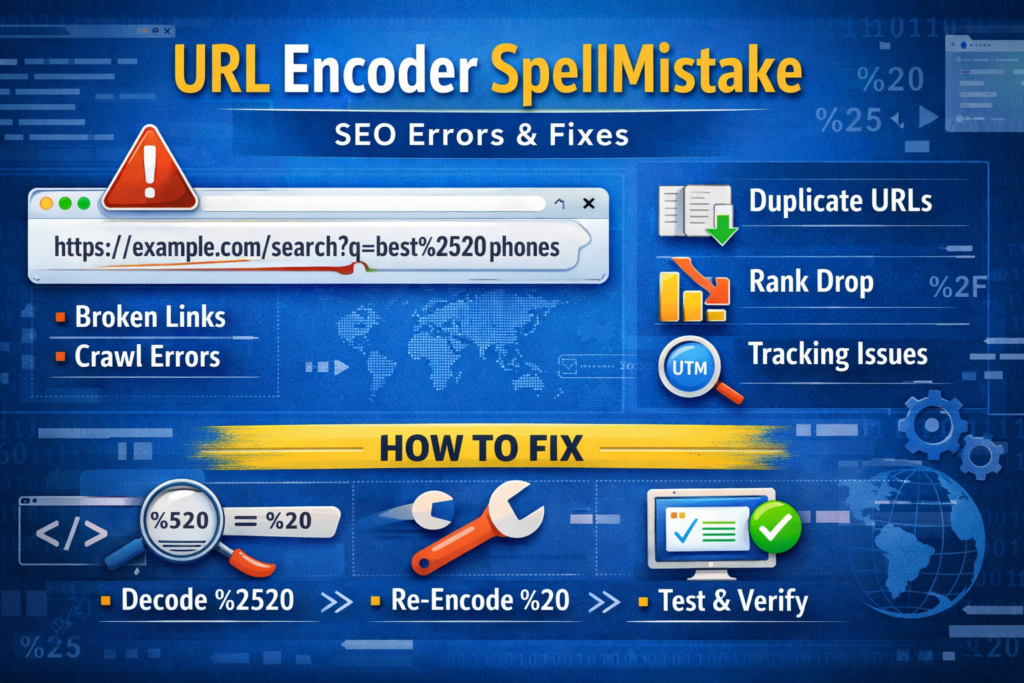

Even the most minor error can have a serious impact in the fast-moving world of technical SEO and web development. There is one such overlooked issue which I call it as a url encoder spellmistake. And while that might seem trivial, this error can lead to broken links, ruin the user experience and even affect search rankings.
In this ultimate guide, we will cover everything there is to know about url encoder spellmistake — what it is, why it occurs, how to fix it and prevent it for good. Well, the answer is pretty simple. You are 21st century generation so feed on that diet. But to be precise If you want tech friendly data and a complete proof of source then there are Highs And Lows Q: How facts can differ from actual reality?
What Is URL Encoding?
You need to first get a sense of what URL encoding actually means before learning a url encoder spellmistake.
Examples of such is URL encoding (also known as percent-encoding) which are used when special or unsafe characters need to be changed into a format that can be transmitted safely over the Internet. It replaces characters with a percent sign (%) and up to 2 hex digits representing the ascii value.
For example:
- Space → %20
- @ → %40
- / → %2F
This mechanism ensures that browsers and servers correctly interpret URLs, particularly in cases where reserved characters are included.
What Is a URL Encoder SpellMistake?
A url encoder spellmistake is any spelling, formatting or implementation mistake that would result in a not encoded hyperlink (or text link) being incorrectly or broken.
- It commonly occurs when:
- Developers mistype encoding functions
- SEO tools generate malformed URLs
- Manual encoding is done incorrectly
- CMS plugins mis-handle special characters
Put simply, a url encoder spellmistake is not an english spelling error — it is the mistake of encoding syntax leading to bad urls.
Does URL Encoding Have an Impact on SEO?
URLs should be properly formatted and clean, search engines much rely on proper URLs. A spellmistake on the url encoder can be detrimental:
Crawlability
Invalid encoding in URLs may prompt search engine bots to struggle to crawl the page.
Indexing Issues
Invalid URLs are bad for the site since such URLs may create duplicate content or indexing errors.
User Experience
Dead or invalid links can decrease trust and increase bounce rate.
Analytics Tracking
UTMs And Campaign Tracking Are Broken With Incorrect Encoding
Since only a limited set of ASCII characters is accepted in URLs, unsafe characters need to be encoded properly for safe passage.
Some common types of URL Encoder SpellMistake
Let’s look into the most common spelling mistakes url encoder that we can observe in real projects.
1. Double Encoding
Example:
- Correct: space → %20
- Wrong: %2520
%25 encodes % meaning the URL is encoded twice
Impact:
- Broken redirects
- 404 errors
- SEO duplication
2. Wrong Hex Values
Example:
- Correct: space → %20
- Error: %2O O is a letter not zero
It often occurs when manually editing the type of this url encoder spellmistake.
3. Encoding Unnecessary Characters
Unreserved characters typically do not require encoding. Over-encoding can confuse systems.
Standards state that unreserved characters must forbore percent-encoding for the sake of interoperability.
4. Mixing + and %20 Incorrectly
Spaces may appear as:
- %20
+(in form encoding)
Inconsistent use is a subtle url encoder spellmistake that makes parameter parsing fail.
5. Incorrect UTF-8 Handling
First non-ASCII characters (Hindi, emojis, accented letters or w/e) have to be converted to UTF-8 bytes before encoding.
If not, you get:
- Garbled URLs
- Redirect failures
- International SEO problems
URL Encoder SpellMistake — A Real-World Example
Broken URL
https://example.com/search?q=best phones in india
Properly Encoded
https://example.com/search?q=best%20phones%20in%20india
Without encoding, spaces are unsafe in URLs and may break requests.
Spaces are not safe for URLs and requests will break without encoding.
How To Find URL Encoder SpellMistake
You are a url encoder spellmistake to the upside down around October 2023.
Use These Methods
Browser inspection
Look for:
- %25 patterns
- strange symbols
- broken redirects
SEO crawlers
Tools such as Screaming Frog or Sitebulb will notify you of mal-formed URLs.
Server logs
Watch for:
- 400 errors
- 404 spikes
- malformed query strings
Manual decoding
Verify against decode if %XX values seem dubious.
Solution (if error is just URL encoder spellMistake)
Follow this proven workflow.
Step 1: Identify the source
See if the error is due to:
- CMS
- JavaScript
- backend
- marketing links
Step 2: Decode the URL
To identify the issue, we can decode parts that are encoded to text.
Example:
Hello%20World → Hello World
Step 3: Re-encode properly
Use trusted functions:
- JavaScript: encodeURIComponent()
- Python: urllib.parse.quote()
- PHP: urlencode()
Step 4: Test in browser
Always verify:
- page loads
- parameters pass correctly
- redirects work
Step 5: Update canonical URLs
But updating canonicals without fixing the url encoder spellmistake can result in duplicate indexing.
The SpellMistake of URL Encoder: Best Practices to Avoid
Professional developers follow these rules:
- Always encode dynamic parameters
Never trust raw user input.
- Avoid manual encoding
Url encoder spellmistake is caused mainly by human error.
- Standardize encoding method
Use the same approach consistently in your stack.
- Validate URLs in CI/CD
Automated checks catch mistakes early.
- Monitor Google Search Console
Identify crawler anomalies or parameter problems.
URL Encoding vs URL Decoding ( in brief)
Many beginners confuse the two.
- Encoding → change special characters to %XX
- Decoding → converts %XX into original
Decoding is as simple as replacing each %XX sequence with its equivalent ASCII character.
Teams incorrectly mixing these processes commonly result in a url encoder spellmistake.
Advanced SEO Influence Of URL Encoder Eye SpellMistake
For serious SEO professionals, the implications can be further-reaching.
Duplicate URLs
The same page in different encodings can result in several indexable URLs.
Parameter Explosion
Invalid encoding can create infinite variations of the URL.
Crawl Budget Waste
Bots waste time on bad URLs instead of important pages.
Broken hreflang
Encoding errors plague international sites terribly.
Audit URL Encoder SpellMistake — Quick Checklist
Use this professional audit list:
- Any %25 where not expected
- Mixed + and %20
- Non-ASCII characters unencoded
- Double-encoded query strings
- Broken redirects
- 404 spikes after campaigns
If you tick even a single checkbox, then you’ve probably got a url encoder 담임보 error problem.
Final Thoughts
It sounds like a small technical bug, but the effect of an url encoder spellmistake can be gigantic on SEO, analytics and user experience. Proper URL encoding makes sure that special characters don’t disrupt how browsers and servers interpret web addresses.
The bad news is those mistakes are very easy to make; the good news is that they’re highly preventable. These involuntary url encoder mistakes can be avoided almost entirely by using standard encoding functions, not editing the encoded output yourself and instituting regular technical audits.
Precision matters in the realm of modern SEO and web development. You fix the small encoding errors today—and you protect your rankings tomorrow.
FAQs
Q1. What is the meaning of url encoder typo?
A url encoder spellmistake is a mistake in the percent-encoding of a URL. This causes link breakages, crawling problems and tracking issues.
Q2. What is a url encoder spellingmistake
The URL Encoder Spellmistake is most often caused by double encoding, manual mistakes in the encoding process, UTF-8 error handling and also improper use of functions in code or CMS tools.
Q3. Q: How to look for jquery url encoder spellmistake?
Beware of decomposed url encoder spellmistakes that occur when you see patterns such as %2520, an ugly hex, bad redirect or invalid URLs that will not load in browsers or SEO crawlers.
Q4. Does a url encoder misspelling make one rank poorly with the Google gods?
Yes. A url encoder typo could adversely affect seo if it causes crawl errors, duplicate urls, wasted crawl budget, and a poor user experience all of which may be damaging to rankings.
Q5. What is the purpose of URL encoding and decoding?
URL encoding replaces unsafe characters with % encoding (e.g., space → %20), and decoding transforms them back into text. These two standalone processes can lead to many spellmistakes of url encoder when they are jumbled up with each other.
Q6. Instructions on fixing a malformatted url encoder spellmistake.
Manual fixes are risky. Standard functions like encodeURIComponent() in JavaScript or urlencode() in PHP should be used instead, so that we do not introduce errors.