
There are not many products that manage to appeal equally to someone with a million followers and someone who just needs to protect their phone before a long commute. Phone case vending machines are doing exactly that, and the conversation around them has been picking up steadily across social media, tech forums, and casual word of mouth. At the centre of it is a format that nobody expected to become a talking point: the Android phone case vending machine that prints a fully custom case on the spot, in minutes, without needing to wait for a delivery or settle for whatever a shop happens to have in stock.
The appeal cuts across demographics in a way that few gadget trends manage. That is worth paying attention to.
How This Started Getting Noticed
Vending machines have been around long enough that nobody films themselves buying a bottle of water from one. But a machine that takes your photo, puts it on a phone case, and hands it back to you in under ten minutes? That is a different story.
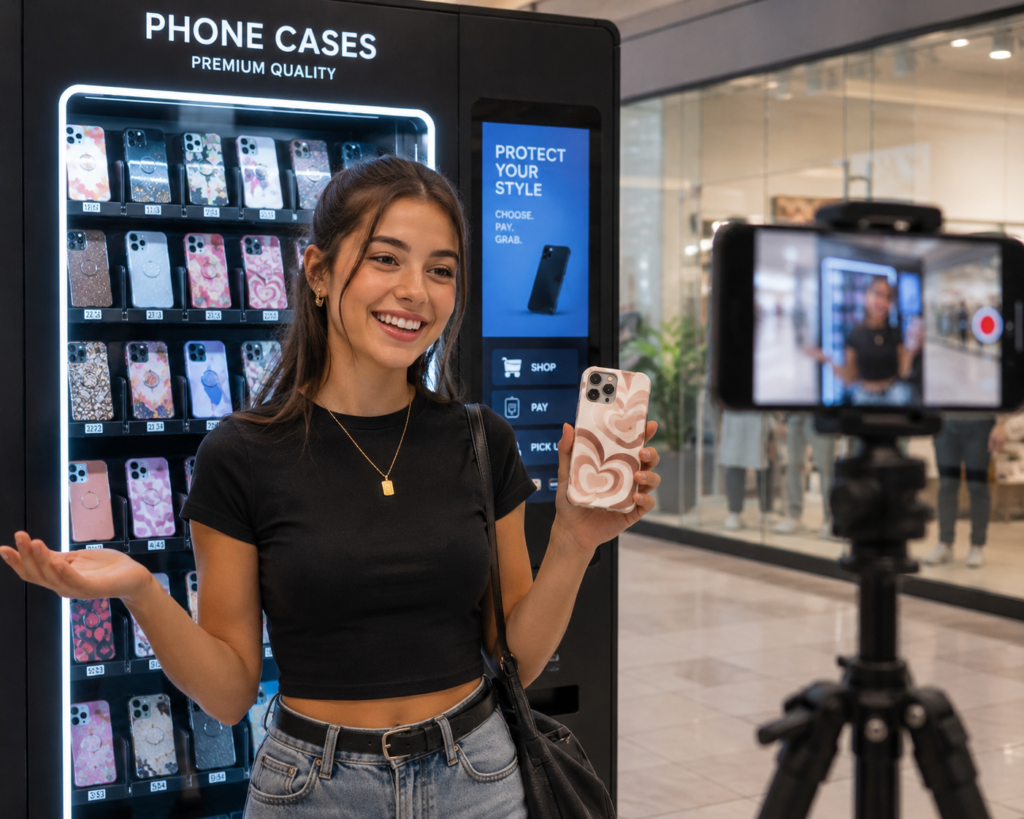
The first wave of attention came from content creators who stumbled across these machines in airports and shopping centres. A short video of the process, from choosing a design to collecting the finished case, turned out to be genuinely watchable. The format is visual, the result is immediate, and the personalisation angle resonates with audiences who are already interested in how people express themselves through their devices.
Those videos performed well. Others followed. And somewhere in the middle of that cycle, everyday users started noticing the machines in their own cities and realising they were not just a novelty for content. They were actually useful.
What Influencers Actually Like About It
For content creators, the phone case is already a considered accessory. It is in every shot, every reel, every thumbnail. The case someone chooses says something about their aesthetic, and for people who have built an audience around a particular look or niche, a generic case from a supermarket shelf is not going to cut it.
Custom cases from vending machines solve that problem in a way that online ordering used to be the only answer for. The difference is speed. Instead of designing something online, waiting a week for delivery, and hoping the colours look right in person, you can walk up to a machine and have something in your hands within minutes.
For influencers who travel constantly, the airport placement of these machines is particularly convenient. A cracked case or a phone that needs a refresh for a new content season is sorted before the flight boards, without needing to plan ahead or carry spares.
Why Everyday Users Are Equally Into It
The influencer angle gets the attention, but the everyday user case is arguably stronger.
Most people do not think about their phone case until something goes wrong. The screen cracks, the case splits, or they drop their phone for the fifth time and decide that their current setup is not cutting it. At that point, the options are usually:
- Order online and wait several days with an unprotected phone in the meantime.
- Walk into a phone shop and choose from a small selection that probably does not include their exact model in anything they actually want.
- Buy something generic from a supermarket that fits poorly and looks like it was designed in 2014.
A vending machine that stocks cases for a wide range of Android models, allows custom printing, and sits in a location you are already passing through removes every one of those frustrations in one go. That is not a niche appeal. That is a solution to a problem that almost every smartphone owner has dealt with at some point.
The Personalisation Factor
There is a broader trend sitting underneath this one. People have become increasingly particular about personalisation across every category of product they buy. Custom trainers, monogrammed accessories, made-to-order everything. The expectation that you should be able to get something that reflects your specific taste rather than choosing from a fixed menu has moved from luxury markets into everyday retail.
Phone cases are a natural fit for that shift. They are small, relatively affordable, highly visible, and changed often enough that people want variety. A machine that lets you upload a photo, choose a colour palette, or design something from scratch and then produces it immediately is meeting that expectation in a physical retail setting, which is still where a significant portion of people prefer to shop when they have the option.
The Android Advantage
Android has the largest share of the global smartphone market by a considerable margin. That means the pool of potential customers for Android-compatible cases is enormous, and it also means that the diversity of models in use at any given time is far wider than on competing platforms.
This is where vending machines with strong Android model support stand out. A machine that covers recent and slightly older Android models across multiple brands captures far more of the people walking past it than one focused on a single manufacturer. For operators, that breadth is a commercial advantage. For customers, it means the machine is actually useful rather than being something that works for everyone except the model they happen to own.
Where the Trend Goes From Here
The current wave of interest in phone case vending machines is not purely about novelty. The machines are getting better, the locations are getting smarter, and the customer experience has improved to the point where the product coming out of the machine competes comfortably with what you would order online.
What tends to happen with trends that have both influencer visibility and genuine everyday utility is that the novelty phase gives way to normalisation. People stop filming themselves using the machine and just use it, the same way they stopped filming themselves using self-checkout. That is not the end of the trend. That is the trend maturing into something that sticks around.
For phone owners, Android users in particular, that is a straightforward win. A better, faster, more personal way to get a case for your phone, available in the places you are already going. It does not need to be a cultural moment to be worth using.