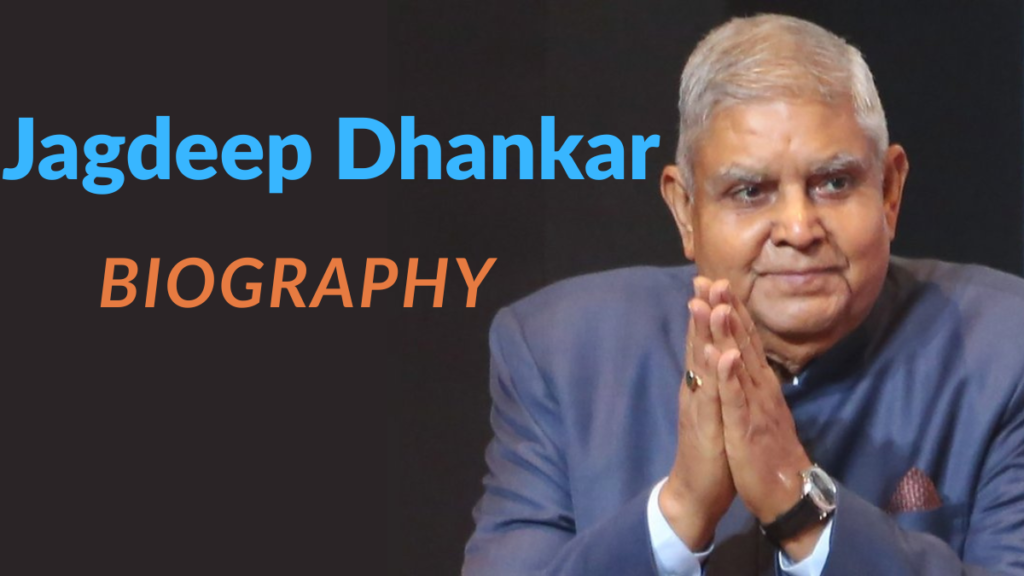

Jagdeep Dhankhar is a distinguished Indian jurist and statesman whose public life seamlessly blends a celebrated legal career with decades of dedicated service in politics and constitutional governance. Rising from a humble rural background in Rajasthan, he built a formidable reputation at the Bar before entering Parliament, where he served as Union Minister of State for Parliamentary Affairs in Prime Minister Chandra Shekhar’s government, contributing to the functioning of India’s parliamentary democracy. His journey then took him to key constitutional roles, including his tenure as Governor of West Bengal, where he became a nationally visible voice on federal and constitutional issues, and finally to the apex of public office as the Vice President of India, the second-highest constitutional authority and Chairman of the Rajya Sabha, where he upheld the spirit and discipline of India’s parliamentary traditions.
Quick Information Table
| Field | Information |
|---|---|
| Full Name | Jagdeep Dhankhar |
| Date of Birth | 18 May 1951 |
| Age | 74 years (as of 2025) |
| Birthplace | Kithana Village, Jhunjhunu District, Rajasthan, India |
| Caste | Jat |
| Nationality | Indian |
| Profession | Advocate, Politician, Constitutional Authority |
| Education | B.Sc. (Physics) – Maharaja’s College, Jaipur; LL.B. – University of Rajasthan |
| Wife | Sudesh Dhankhar |
| Children | One Daughter – Kamna Dhankhar |
| Jagdeep Dhankhar Son | Not applicable (no verified public record of a son) |
| Political Parties Associated With | Janata Dal, Indian National Congress, Bharatiya Janata Party (BJP) |
| Previous Offices Held | MP (9th Lok Sabha), Union Minister of State for Parliamentary Affairs, MLA (Rajasthan), Governor of West Bengal, Vice President of India |
| Vice President of India | 14th Vice President (2022–2025) |
| Governor of West Bengal | 2019–2022 |
| Union Minister of State for Parliamentary Affairs | 1990–1991 (Chandra Shekhar Government) |
| Legal Career Highlights | Senior Advocate, Rajasthan High Court; President, Rajasthan High Court Bar Association |
| Known For | Constitutional expertise, parliamentary discipline, federal governance |
| Social Media |
Early Life and Family Background
Jagdeep Dhankhar was born on 18 May 1951 in the small village of Kithana in the Jhunjhunu district of Rajasthan, into a traditional Hindu family belonging to the Jat caste — a land-owning agrarian community with significant influence across northern India’s socio-political landscape.
His parents, Gokal Chand (father) and Kesari Devi (mother), were farmers. Dhankhar’s upbringing was rooted deeply in rural values, with early life spent amidst farming fields and a community that prized resilience and self-improvement. This environment instilled in him an enduring work ethic and a grounded worldview.
Jagdeep Dhankhar is married to Sudesh Dhankhar, whom he wed in 1979. Sudesh herself is an accomplished woman, having completed higher education and eventually earning a Ph.D. in Economics, with her research focusing on groundwater conservation in Rajasthan’s Jhunjhunu district. She has been actively involved in social work, particularly in areas of women’s empowerment, education, and environmental conservation. As the spouse of the Vice President, she played a complementary role in supporting various causes during Dhankhar’s tenure.
From their marriage, Jagdeep and Sudesh Dhankhar have one daughter named Kamna. Kamna is married to Kartikeya Vajpayee.
Education and Formative Years
Education played a transformative role in Dhankhar’s life. He began his schooling at local government institutions in his village and nearby areas. Recognizing his potential early on, his family encouraged him to pursue academic excellence. He earned admission to the prestigious Sainik School in Chittorgarh on a merit scholarship — a turning point that exposed him to structured discipline and leadership values.
After completing his schooling, Dhankhar pursued a Bachelor of Science (Honors) in Physics from Maharaja’s College, Jaipur (affiliated with the University of Rajasthan). Later, driven by a passion for law and justice, he enrolled in the LL.B. program at the University of Rajasthan, Jaipur, completing his legal education in 1979.
These formative academic experiences not only equipped him with analytical and legal skills but also instilled in him a deep appreciation for constitutional principles, rights, and duties — themes that would recur throughout his public life.
Also read: Dr. Rajendra Prasad(First President of India) || Rahul Gandhi (Leader of Opposition)
Legal Career: The Foundation of Public Life
After completing his law degree in 1979, Dhankhar enrolled with the Bar Council of Rajasthan and began practicing as an advocate. His legal career took off rapidly — he developed a reputation for exceptional advocacy, particularly in constitutional law, arbitration, and inter-state legal disputes. His courtroom proficiency earned him respect across legal circles, and in 1990, he was designated a Senior Advocate by the Rajasthan High Court — an honor bestowed on lawyers of high integrity and expertise.
During this period, Dhankhar also served as the President of the Rajasthan High Court Bar Association, enhancing his reputation as a leader among his peers. He argued significant cases before the Supreme Court of India and high courts across the country, often involving intricate constitutional and civil matters.
This distinguished legal career laid the foundation for his entry into national politics, providing him both visibility and a solid grounding in issues of law and justice — core elements of democratic governance.
Political Career and Party Associations
Dhankhar’s political journey began in the late 1980s, when he aligned with the Janata Dal, a key party in the post-Emergency political realignment of India. Contesting from Jhunjhunu in Rajasthan, he was elected to the 9th Lok Sabha (1989–1991), during which he also served as Union Minister of State for Parliamentary Affairs in Prime Minister Chandra Shekhar’s government.
His early political engagement reflected his commitment to parliamentary democracy and governance. He drew particular inspiration from Devi Lal, a senior leader from Haryana and a prominent figure among farmers and rural constituencies. This association early in his political career influenced Dhankhar’s ideological engagement with grassroots issues and agrarian concerns.
In 1991, he joined the Indian National Congress under the leadership of Prime Minister P.V. Narasimha Rao, contesting the Ajmer seat — though unsuccessfully — and later serving as a Member of the Rajasthan Legislative Assembly (MLA) from Kishangarh between 1993 and 1998.
The next major shift in his political alignment occurred in 2003, when he joined the Bharatiya Janata Party (BJP). This move coincided with the resurgence of the BJP in Rajasthan and across India. Over the years, Dhankhar became a senior figure in the party’s legal and organizational efforts in the state and nationally. His broad experience across multiple parties — Janata Dal, Congress, and BJP — reflects a nuanced engagement with India’s shifting political landscape.
Constitutional Offices: Governor, Vice President, and National Leadership
Governor of West Bengal (2019–2022)
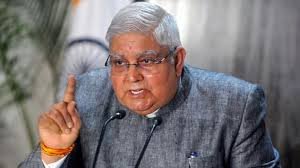
In July 2019, Jagdeep Dhankhar was appointed as the Governor of West Bengal, one of India’s most politically significant states. His tenure was marked by robust engagement with issues of constitutional governance and frequent high-profile exchanges with the state government, particularly regarding law and order, administrative autonomy, and federal balance.
These interactions brought Dhankhar national attention, showcasing his assertive style of constitutional interpretation and engagement with political processes at the state and national levels.
Vice President of India (2022–2025)
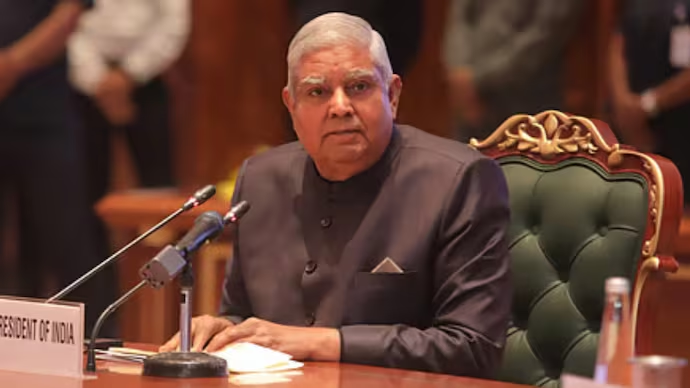
In July 2022, the National Democratic Alliance (NDA) — led by the BJP — nominated Jagdeep Dhankhar as its candidate for Vice President of India. On 6 August 2022, he won the vice-presidential election with a historic margin, securing an overwhelming number of votes from the electoral college.
He was sworn in on 11 August 2022 as the 14th Vice President of India and, by constitutional design, became the Chairman of the Rajya Sabha (the Upper House of Parliament). In this role, he was responsible for presiding over parliamentary proceedings, ensuring order and decorum, and facilitating legislative discourse — tasks he performed with his trademark legal rigor and constitutional focus.
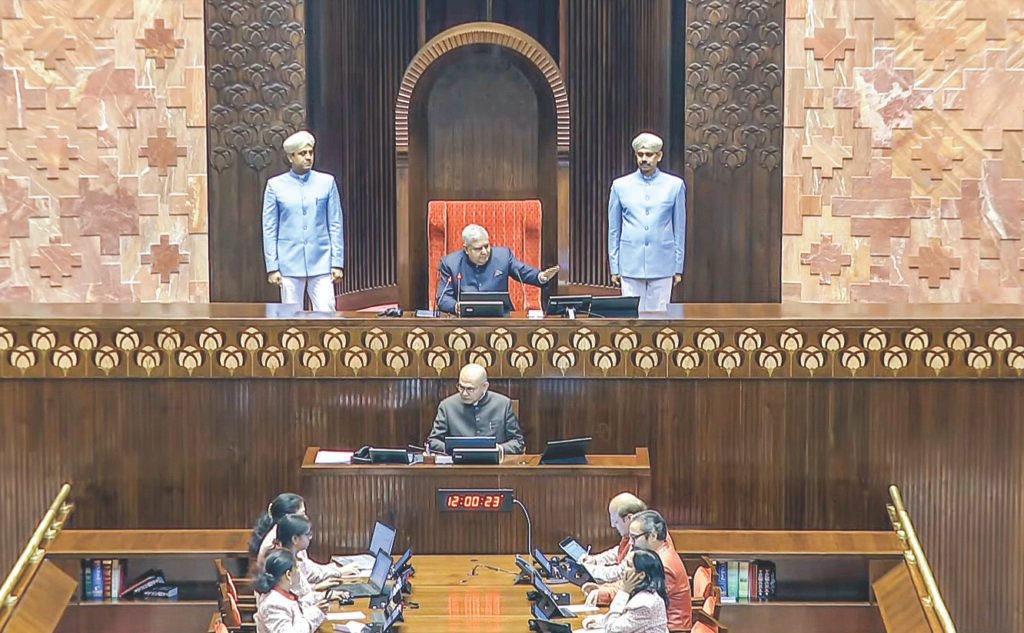
Dhankhar’s vice-presidential tenure was highly visible, marked by active engagement in parliamentary affairs, outreach to youth and scholars, and international representation of India’s democratic ethos. However, in July 2025, citing health concerns, he tendered his resignation from the Vice Presidency, becoming one of the few holders of the office to step down mid-term. His resignation was accepted by the President of India, Droupadi Murmu.
Legacy and Public Perception
Jagdeep Dhankhar’s legacy is multifaceted:
- He is admired for his legal acumen and incisive understanding of constitutional law.
- His political career spans national and state legislatures, ministerial office, and constitutional leadership, reflecting experience across the full range of India’s democratic institutions.
- His ability to navigate complex political environments — from grassroots politics to high constitutional office — has earned him respect across diverse segments of Indian society.
- As Vice President, he emphasized parliamentary discipline and constitutional ethics, often advocating for greater decorum and respect for democratic norms in public discourse.
Conclusion
Jagdeep Dhankhar’s life stands as a powerful example of how intellect, integrity, and perseverance can shape a nation’s public life. From a small village in Rajasthan to the highest corridors of constitutional authority, his journey reflects the strength of India’s democracy, where dedication and merit can rise above circumstance. His distinguished legal career gave him a deep respect for the Constitution, which later defined his conduct as a parliamentarian, minister, Governor, and ultimately as the Vice President of India and Chairman of the Rajya Sabha.
Across every role, he stood for parliamentary discipline, constitutional values, and democratic integrity. More than the positions he held, his true legacy lies in the standards he upheld — dignity in public life, respect for institutions, and unwavering commitment to the rule of law.
FAQs
Why did Jagdeep Dhankhar resign?
Vice President Jagdeep Dhankhar resigned from office, citing health concerns and the need to follow medical advice. His resignation, addressed to President Droupadi Murmu, comes into effect immediately under Article 67(a) of the Constitution.