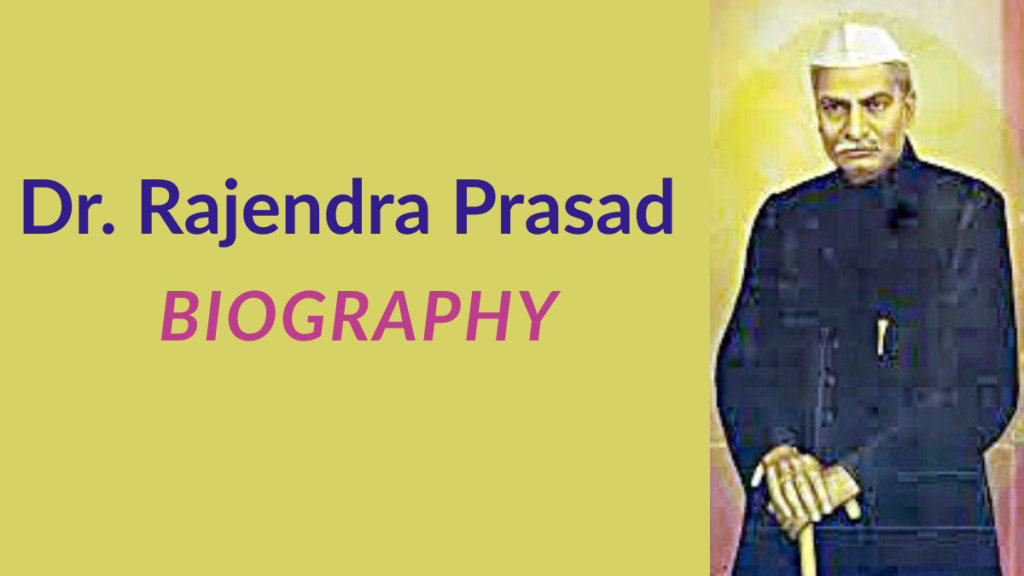

Dr. Rajendra Prasad, the Bharat Ratna awardee, was a towering statesman who rose from the state of Bihar to become the first President of independent India and the President of the Constituent Assembly. A brilliant lawyer with a doctorate in law, he combined rare intellectual excellence with deep moral strength. From the courtrooms of Calcutta and Patna to the historic halls where India’s Constitution was framed, his life journey reflects the story of a nation in the making — guided by simplicity, sacrifice, and an unshakable commitment to truth.
Quick Information
| Field | Details |
|---|---|
| Full Name | Dr. Rajendra Prasad |
| Born | 3 December 1884, Ziradei, Siwan, Bihar |
| Parents | Mahadev Sahai (Father), Kamleshwari Devi (Mother) |
| Education | Presidency College, Calcutta; University of Calcutta (M.A. Economics, Law, Doctorate in Law) |
| Profession | Lawyer, Freedom Fighter, Statesman |
| Major Movements | Champaran Satyagraha, Non-Cooperation, Civil Disobedience, Salt Satyagraha, Quit India |
| Key Positions | President of Constituent Assembly; President of Indian National Congress (1934, 1939, 1947); First President of India (1950–1962) |
| Institutions | First Principal, Bihar Vidyapeeth (1921); Founder, Bihar Students’ Conference (1906); Founder, Bihar Law Weekly |
| Journalism | Editor – Desh (Hindi); Searchlight (English) |
| Major Books | India Divided, Atmakatha, Bapu Ke Kadmon Mein, Satyagraha at Champaran |
| Award | Bharat Ratna (1962) |
| Wife | Rajvanshi Devi |
| Passed Away | 28 February 1963 |
Early Life and Family Background
Dr. Rajendra Prasad was born on 3 December 1884 in the village of Ziradei, in the Siwan district of Bihar (then part of the Bengal Presidency). His father, Mahadev Sahai, was a scholar of Sanskrit and Persian, and his mother, Kamleshwari Devi, was a deeply religious and compassionate woman who shaped his values of simplicity, discipline, and devotion.
Growing up in a traditional Indian household, young Rajendra was exposed early to Indian culture, scriptures, and moral teachings. His home environment nurtured in him a deep respect for learning, truth, and service, qualities that would define his entire life.
Early Schooling and Education
Rajendra Prasad was an exceptionally brilliant student from childhood. He began his schooling at the local village school and later joined Chapra Zila School, where his academic excellence became evident. His teachers often spoke of his extraordinary memory and sharp intellect.
He went on to study at Presidency College, Calcutta, one of the most prestigious institutions of the time. There, he earned a First Class degree in Science and later in Arts. He completed his Master’s degree in Economics with top honors, and then pursued Law at the University of Calcutta, again securing a First Class.
His academic achievements were so outstanding that the examiners wrote on his answer sheet: “Examinee is better than the examiner.” This single sentence became legendary, reflecting his rare intellectual brilliance.
Career as a Law Professional and Famous Court Cases
After completing his education, Dr. Rajendra Prasad began a highly successful legal career at the Calcutta High Court and later at the Patna High Court. He quickly earned a reputation as one of the finest lawyers in eastern India – honest, disciplined, and deeply principled.
He appeared in several important civil and criminal cases, especially those involving Indian peasants and nationalists who were being harassed by the British authorities. Many of his famous cases were connected to:
- Indigo farmers and peasants in Bihar
- Political prisoners charged under colonial laws
- Freedom fighters accused during the Non-Cooperation and Civil Disobedience movements
Instead of chasing wealth, he often reduced or waived his fees for poor clients, believing that law was a service to society, not merely a profession.
Entry into the Freedom Struggle
Dr. Rajendra Prasad’s life changed forever when he met Mahatma Gandhi during the Champaran Satyagraha (1917). Deeply inspired by Gandhi’s ideals of truth and non‑violence, he left his flourishing legal career to dedicate himself fully to India’s freedom movement.
Champaran Satyagraha
In Champaran, Bihar, British indigo planters were brutally exploiting poor farmers. Rajendra Prasad became one of Gandhi’s closest associates during this movement, organizing villages, collecting evidence, and helping peasants fight injustice. This was his first major step into national leadership.
Non‑Cooperation Movement (1920–22)
He played a leading role in the Non‑Cooperation Movement, resigning from government positions and encouraging Indians to boycott British institutions. During this time, he became the first Principal of Bihar Vidyapeeth, established on 6 February 1921 by Mahatma Gandhi and Maulana Mazharul Haque, to promote national education free from colonial influence.
Civil Disobedience and Salt Satyagraha
Dr. Rajendra Prasad actively participated in the Civil Disobedience Movement and Salt Satyagraha (1930). For defying British laws, he was repeatedly arrested and imprisoned, spending many years in jail. Yet prison never broke his spirit; instead, it deepened his faith and commitment to freedom.
Quit India Movement (1942)
During the Quit India Movement, he was once again imprisoned. Despite harsh conditions, he continued writing, studying, and guiding young freedom fighters from behind bars.
Leadership in the Indian National Congress
Dr. Rajendra Prasad became a towering figure in the Indian National Congress. He was elected President of the Congress three times – in 1934, 1939, and 1947 – guiding the party during some of its most critical years, including the transition to independence.
His calm leadership, moral authority, and ability to unite people made him one of the most respected leaders in the organization.
Role in the Interim Government (1946–47): Ministries and Departments
When the Interim Government of India was formed on 2 September 1946 under Jawaharlal Nehru, Dr. Rajendra Prasad was entrusted with some of the most important portfolios. He served as the Minister for Food and Agriculture, later also handling Relief and Rehabilitation during the traumatic months of Partition. In these roles, he worked tirelessly to address acute food shortages, stabilize agricultural production, and coordinate relief for millions of refugees pouring into India from across the newly drawn borders. His administrative skill, compassion, and integrity were crucial in shaping early policies for food security, rural development, and refugee rehabilitation, laying a humane foundation for the functioning of independent India’s government.
Role in Framing the Constitution of India
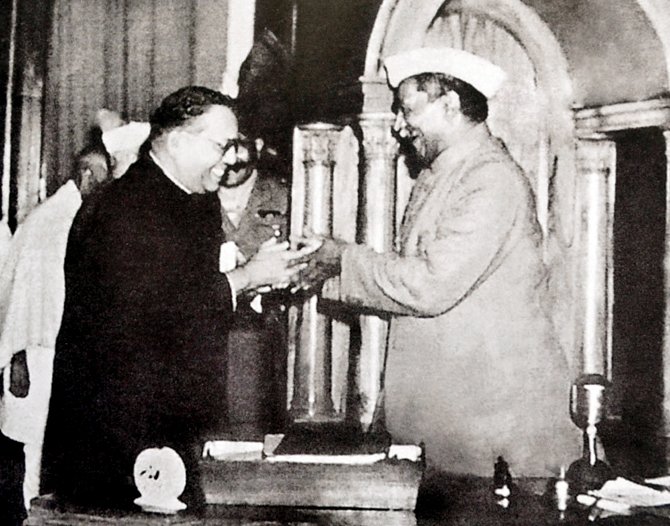
Dr. Rajendra Prasad played a historic and decisive role in the making of the Indian Constitution. The Constituent Assembly of India first met on 9 December 1946, and just two days later, on 11 December 1946, he was unanimously elected as the President of the Constituent Assembly. From this position, he guided the Assembly through nearly three years of intense debate, discussion, and nation‑shaping decisions.
With calm authority and deep constitutional wisdom, he ensured that every voice was heard and every issue was examined with fairness. Under his presidentship, the Constituent Assembly completed its work and adopted the Constitution on 26 November 1949, concluding its historic journey of constitution‑making. Dr. Rajendra Prasad’s leadership ensured that the Constitution reflected India’s democratic spirit, unity in diversity, and commitment to justice, liberty, equality, and fraternity.
First President of India
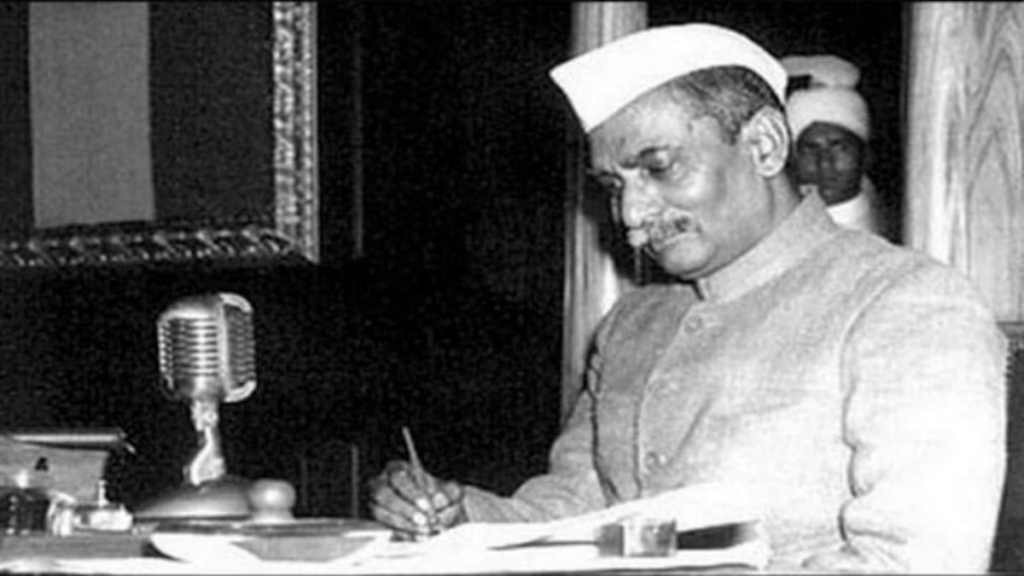
On 26 January 1950, Dr. Rajendra Prasad became the first President of India. He served two full terms, till 1962, setting the highest standards for the office.
As President, he lived a life of simplicity, refusing luxury and remaining deeply connected to ordinary people. He travelled across the country, strengthening national unity, promoting education, culture, and social harmony.
In 1962, he was awarded the Bharat Ratna, India’s highest civilian honor, for his extraordinary service to the nation.
Literary Works and Journalism
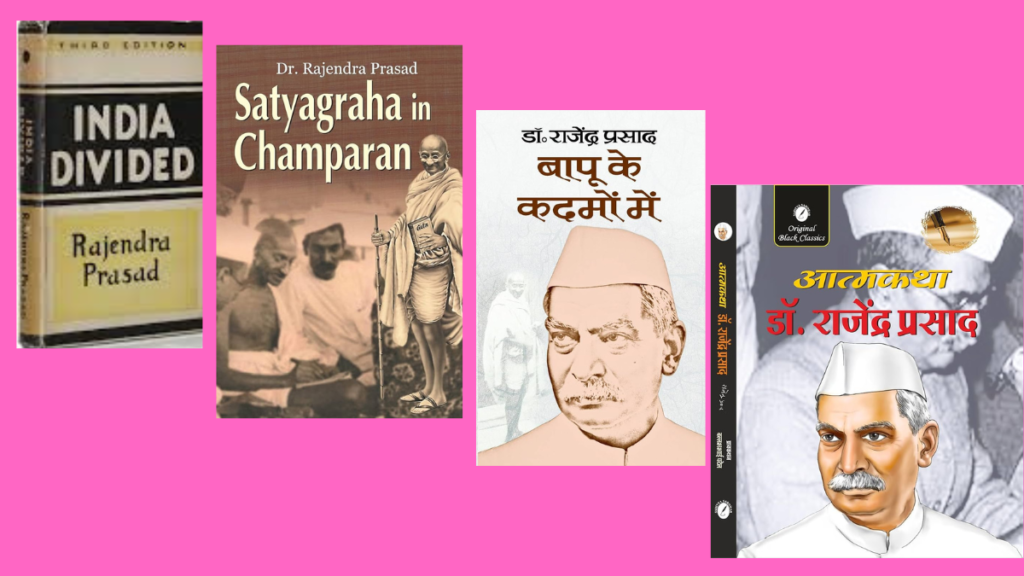
Dr. Rajendra Prasad was also a great writer and thinker. His literary contributions include:
Books
- India Divided – on the partition of India
- Atmakatha (Autobiography)
- Bapu Ke Kadmon Mein – memories of Mahatma Gandhi
- Satyagraha at Champaran
Journalism
He served as:
- Editor of the Hindi weekly “Desh”
- Editor of the English bi‑weekly “Searchlight”
He also founded the Bihar Law Weekly, contributing greatly to legal journalism.
Contribution to Education and Youth Movements
Dr. Rajendra Prasad believed that education was the true foundation of Swaraj. For him, political freedom without intellectual and moral awakening was incomplete. His contribution to education and youth movements was therefore as important as his role in mass politics.
Bihar Students’ Conference (1906)
In 1906, he was instrumental in establishing the Bihar Students’ Conference, the first organized student movement in the region. Through this platform, he awakened political consciousness among young Indians, encouraging them to combine academic excellence with national service. The Conference became a nursery of future freedom fighters and leaders who later played important roles in the national movement.
National Education and Bihar Vidyapeeth
During the Non‑Cooperation Movement, Dr. Rajendra Prasad fully supported Mahatma Gandhi’s call to boycott British educational institutions. When Bihar Vidyapeeth was established on 6 February 1921 by Mahatma Gandhi and Maulana Mazharul Haque, he became its first Principal, shaping it into a centre of nationalist education.
Under his leadership, Bihar Vidyapeeth emphasized:
- Education rooted in Indian culture and values
- Character building and discipline
- Social service and village upliftment
- Training youth for constructive national work
Thousands of students left government colleges to join Bihar Vidyapeeth, inspired by his personal example of sacrifice and simplicity.
Also read: Rahul Gandhi
Promotion of Women’s and Rural Education
Dr. Rajendra Prasad strongly supported women’s education and worked with leaders like Rajkumari Amrit Kaur and Kasturba Gandhi to encourage girls’ schooling in Bihar. He also promoted rural education, believing that India would rise only when its villages were enlightened. He helped organize literacy drives, village libraries, and study circles to spread awareness among peasants and workers.
Youth as Nation‑Builders
He constantly addressed students, reminding them that they were the “architects of free India.” He urged them to combine knowledge with character, freedom with responsibility, and idealism with discipline. His speeches and writings in Desh and Searchlight became guiding lights for the younger generation.
Through these efforts, Dr. Rajendra Prasad transformed education into a powerful instrument of nation‑building, proving that classrooms and campuses were as important as prisons and protest marches in the struggle for freedom.
Personal Life and Wife
Dr. Rajendra Prasad married Rajvanshi Devi at a young age, in keeping with the customs of the time. She remained a quiet pillar of strength throughout his life, supporting his national service with patience and dignity.
Despite occupying the highest offices of the country, Dr. Rajendra Prasad lived a life of remarkable simplicity. He followed a disciplined routine, wore simple khadi clothes, and remained deeply spiritual. He believed that a leader must live like the poorest citizen of the nation. His personal life reflected the values he preached — humility, honesty, self-control, and compassion.
Conclusion
Dr. Rajendra Prasad’s life stands as a timeless example of how learning, character, and courage can shape a nation’s destiny. From a small village in Bihar to the highest constitutional office of India, he never lost his humility or his faith in service
As a lawyer, he fought injustice; as a freedom fighter, he embraced suffering for the country; and as President, he upheld the dignity of the Republic with unmatched grace. More than titles or honours, it is his spirit of sacrifice and simplicity that makes him immortal in India’s history.